Dr. Ball
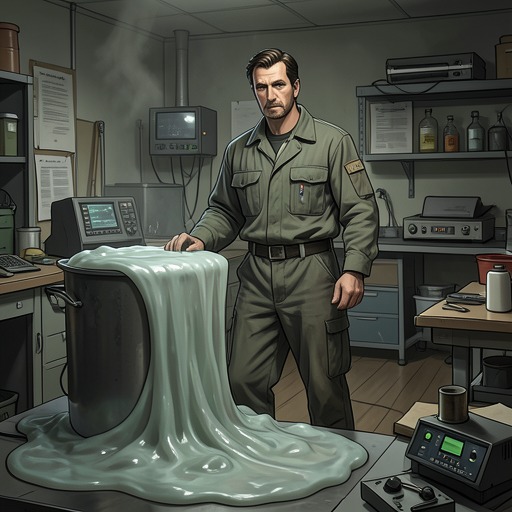
The Robot Who Looked Like MeDr. Ball is the TexasTower doctor who diagnoses Joe Pareti with Ashton’s Disease and explains how little is known about its shifting effects. Tall, thin, quiet, and orderly, he brings medical authority to a condition defined by uncertainty; his conspicuous enthusiasm for discussing that uncertainty, however, makes the sickbay feel less like a place of care than a laboratory where Pareti has become an object of study.
Identity and Introduction
Ball first appears when Pareti, alarmed by his sudden hairlessness, goes looking for the TexasTower doctor. Ball is not in the sickbay but in the pharmacology lab. After one look at Pareti, he leads him back to the sickbay, where he confirms what Pareti fears: the change is Ashton’s Disease, also known as Goo infection, named after the first case.
The description establishes a tension in Ball’s manner. He is quiet and orderly, and ordinarily inclined to gloom, yet Pareti’s condition makes him cheer perceptibly. The response marks him as a physician fascinated by the disease even as his patient confronts it as a threat to his body and identity. Pareti feels that he has entered the sickbay as a man and is being treated there as a diseased culture under examination. Ball’s professional composure does not ease that transformation; his evident interest sharpens it.
Diagnosis and Medical Uncertainty
Ball names the infection, then frames its defining feature as the instability of its symptoms. Pareti’s case is atypical, he explains, but that very atypicality is typical of the disease. He presents the diagnosis as part of a tiny and inconclusive record: Pareti is only the sixth known case, and no clear pattern has been established. Ball describes the disease as unstable, like its progenitor, the Goo.
The few precedents he recounts offer little reassurance. The first patient died within a week of contracting the disease, apparently from a pneumonic complication. Another case—the fourth—is still alive, but Ball does not consider that person normal: the patient’s relationship with mushrooms has become a reciprocated, perverted love, and some researchers suspect the patient has become a kind of intelligent mushroom. These examples leave Pareti with no dependable course to expect. Ball can offer a framework for thinking about the disease, but not a prognosis that would settle what will happen to his patient.
The Pattern Ball Describes
When Pareti presses him to explain what the cases have in common, Ball identifies a radical change in the victim’s relationship with the external world. The transformations may be animate: some victims grow external organs or functional gills. They may also involve the inanimate world: one victim levitated. The examples do not amount to a predictable sequence of symptoms. Instead, they suggest that the disease can alter the boundary between a person and the world around them in radically different ways.
Ball’s explanation makes the condition more unsettling even as it supplies a provisional pattern. Pareti is not simply waiting to learn whether a familiar symptom will worsen; the possible changes reach beyond the body into its relation with other forms of life and with objects. Ball’s account is medically cautious—he stresses that the evidence is sparse and resists claiming a firm pattern—but its speculative cases leave the patient facing possibilities that cannot be ranked or ruled out.
Conflict in the Sickbay
Ball’s uncertainty becomes a source of conflict because he continues his recitation while Pareti is trying to make sense of what has happened to him. Pareti grows impatient with the doctor’s manner and demands that he stop withholding the point. Ball eventually gives his account of the pattern, but the exchange does not restore trust. When Pareti asks whether that is everything Ball has to tell him, Ball nods with an insipid grin.
Pareti then crosses the room and punches him. He strikes Ball in the stomach, holds him under the chin, and drives a second blow into his nose. Ball crashes against a glass-fronted instrument case, breaking the glass, and falls to the floor conscious but in pain. Pareti turns toward the door, then looks back with his first smile since entering the sickbay and makes a cutting remark about Ball’s bedside manner. The episode ends on that reversal: the doctor who had treated Pareti as a case becomes the injured body in the room, while Pareti briefly recovers some sense of agency through violence.
Narrative Role
Ball’s role is limited but consequential. He supplies the diagnosis and the history that establish Ashton’s Disease as radically unpredictable, while his manner makes the delivery of medical knowledge part of Pareti’s distress. The scene does not show Ball’s subsequent response or establish what happens to him after the assault. Its emphasis is instead on the collision between clinical explanation and a patient’s immediate experience: Ball can classify the disease and recount its strange precedents, but that expertise cannot give Pareti certainty or make him feel less dehumanized.